There are more free data science resources than anyone can finish, so the hard part is choosing. This guide lists the ones I would actually point a beginner to, says what each is good for, and flags where “free” has a catch. Prices and course details were checked on 20 November 2026 and can change.
Start here: pick one course, one dataset, one project
- One course that teaches by doing. Kaggle Learn offers short, no-cost courses on Python, pandas, data visualization and machine learning, all run in a browser notebook, so there is nothing to install.
- One dataset you find interesting. The UCI Machine Learning Repository currently lists 708 datasets, and Our World in Data publishes charts and data that are CC BY licensed unless stated otherwise.
- One small project you finish and publish. Finishing one beats starting five.
Free courses worth your time
Practical learning
- Kaggle Learn: short lessons with exercises. Best first stop for pandas and basic machine learning.
- fast.ai, Practical Deep Learning for Coders: free, and it expects roughly a year of coding (Python preferred) and high school maths. Take it after you are comfortable with Python.
- Hugging Face Learn: lists courses on LLMs, agents, diffusion models, computer vision and audio. Good once you want to work with modern models.
University material
- MIT OpenCourseWare: free course materials with no registration required, over 2,500 courses by its own count. You get lectures and problem sets, not a certificate or feedback.
Certificates: read the fine print
The Google Data Analytics Professional Certificate is often described as free. On Coursera it starts with a 7-day free trial, then costs $49 a month in the US and Canada, though financial aid is available. Older lists, including an earlier version of this post, treat it as free. It is not, so budget for it or apply for aid.
Free datasets for practice
- UCI Machine Learning Repository: 708 datasets, many small and clean, good for first models.
- OpenML: an open platform for sharing datasets, algorithms and experiments, useful once you want to compare your model with others.
- Our World in Data: real-world data on health, energy, population and more, with downloadable charts.
- Kaggle: datasets plus notebooks from other people, which are a good way to see how others clean data.
A 10-minute exercise with a real free dataset
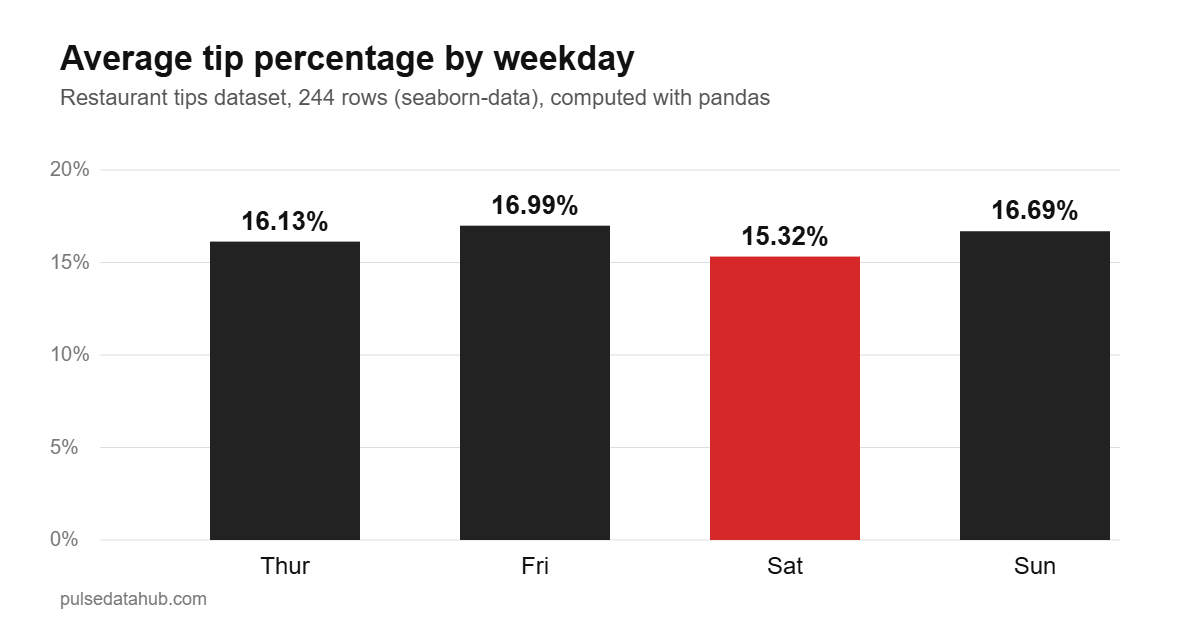
Do not just collect links. This script loads the classic restaurant tips dataset from the public seaborn-data repository, checks its shape and types, and answers one question: how does the tip percentage change by weekday? I ran it with pandas on 20 November 2026.
import pandas as pd

url = "https://raw.githubusercontent.com/mwaskom/seaborn-data/master/tips.csv"
df = pd.read_csv(url)

print(df.shape)
print(df.dtypes.to_string())
print(df.isna().sum().sum())

df["tip_pct"] = df.tip / df.total_bill * 100
print(df.groupby("day", observed=True).tip_pct.mean().round(2).to_string())
print(df[["total_bill", "tip", "size"]].corr().round(3).to_string())
Output from that run:
(244, 7)
total_bill    float64
tip           float64
sex               str
smoker            str
day               str
time              str
size            int64
0
day
Fri     16.99
Sat     15.32
Sun     16.69
Thur    16.13
            total_bill    tip   size
total_bill       1.000  0.676  0.598
tip              0.676  1.000  0.489
size             0.598  0.489  1.000
What this shows: the file has 244 rows and 7 columns with no missing values, and the total bill and tip are strongly related (correlation 0.676). Average tip is about 17.0% on Friday, 16.7% on Sunday, 16.1% on Thursday and 15.3% on Saturday. With only 244 rows, and few of them on Friday, treat the weekday differences as a starting question, not a conclusion. That habit, checking shape, types, missing values and sample size before trusting a number, is the most useful thing a free course will teach you.
Where to go next on Pulse Data Hub
- Build a machine learning model with scikit-learn
- Sentiment analysis with Python
- GitHub for data science, for publishing the project you finish
- Data science career guide
Frequently asked questions
Can I learn data science for free?
Yes, the learning material is free: courses, documentation and datasets. What you pay with is time, and certificates, mentoring or feedback are usually the paid parts.
What should I learn first?
Python and pandas, then basic statistics, then machine learning. Do each with a dataset you care about.
Do free certificates help me get a job?
A finished project you can explain usually says more than a certificate. Publish your work and be ready to walk through your choices.