Quantum Computing for Data Science: A Grover Simulation
Quantum computing for data science is surrounded by large claims, so this article does something small and checkable: it simulates the best-known quantum search method, Grover’s algorithm, in about ten lines of NumPy, and measures what it does and what it costs to simulate. Everything here runs on an ordinary classical computer; we did not use quantum hardware, and nothing below shows a practical data-science speed-up. Computed with NumPy 2.5.3.
What Grover’s algorithm does
Suppose you have N unsorted items and a yes/no test that recognises the one you want. A classical search checks items one at a time and needs N/2 checks on average. Grover’s algorithm starts with an equal superposition over all items, then repeats two steps: the oracle flips the sign of the marked item’s amplitude, and the diffusion step reflects all amplitudes around their average. Each round raises the marked item’s amplitude, so after about (pi/4) times the square root of N rounds, measuring finds it with high probability. That is a square-root speed-up in the number of oracle calls, not an exponential one.
A simulation in NumPy
import numpy as np

def grover(n_qubits, marked, iterations):
    N = 2 ** n_qubits
    psi = np.full(N, 1 / np.sqrt(N), dtype=np.complex128)   # equal superposition
    probs = []
    for k in range(iterations + 1):
        probs.append(abs(psi[marked]) ** 2)
        psi[marked] *= -1                 # oracle: flip the marked amplitude
        psi = 2 * psi.mean() - psi        # diffusion: reflect about the mean
    return probs
Results
| Qubits | Items (N) | Optimal iterations | Success at optimum | Classical average checks |
|---|---|---|---|---|
| 4 | 16 | 3 | 96.1% | 8 |
| 8 | 256 | 13 (peak at 12: 99.99%) | 98.6% at 13 | 128 |
| 10 | 1,024 | 25 | 99.95% | 512 |
| 12 | 4,096 | 50 | 99.99% | 2,048 |
For 4096 items, 50 oracle calls found the marked item with 99.99% probability, against about 2,048 checks classically, matching the square-root scaling. As a check, we built the same 3-qubit search from explicit Hadamard, oracle and diffusion matrices and got success probabilities of 78.1%, 94.5% and 33.0% after 1, 2 and 3 iterations, the known values for N = 8.
More iterations make it worse
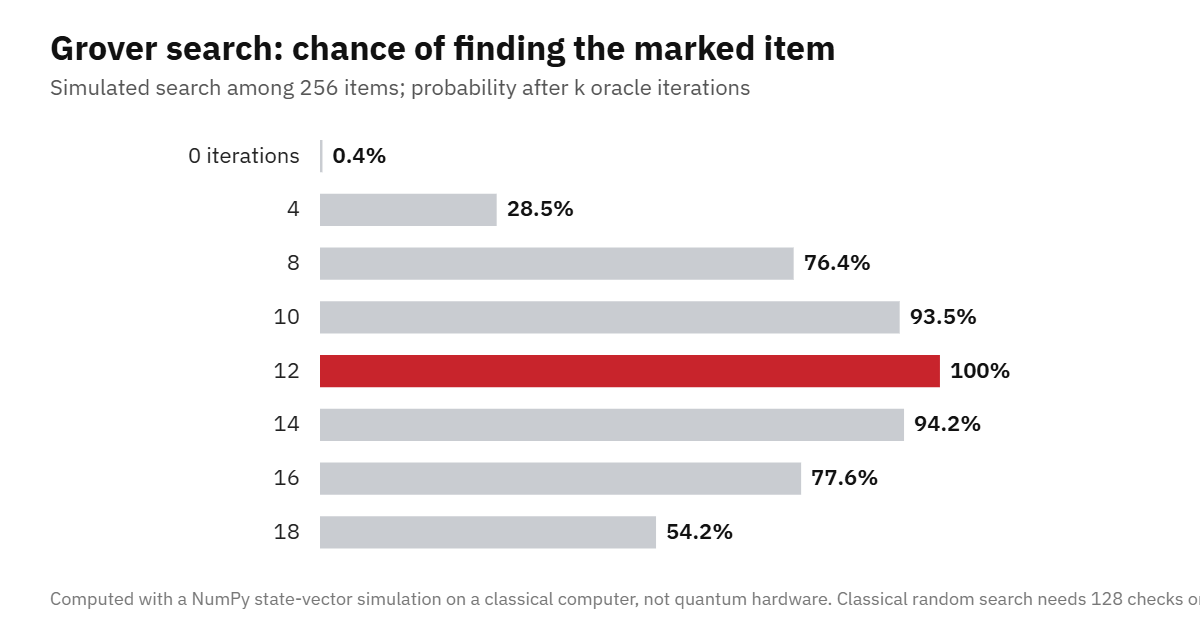
Grover’s algorithm is not “keep going until it works”. For 256 items the success probability climbed to 100% at 12 iterations, then fell: 94.2% at 14, 54.2% at 18, and by twice the optimum it was only 3.0%. With 4 qubits, doubling the iterations dropped success from 96.1% to 2.0%. You must know the right number of rounds in advance, which needs a known number of marked items.
Why classical simulation does not scale
| Qubits | Memory for state | Time per iteration (this machine) |
|---|---|---|
| 18 | 4.2 MB | 1.6 ms |
| 22 | 67 MB | 37.8 ms |
| 24 | 268 MB | 161 ms |
| 30 (calculated) | 17 GB | – |
| 50 (calculated) | about 18 petabytes | – |
The state vector has 2 to the power n entries of 16 bytes each, so memory and time quadruple with every extra two qubits. We measured up to 24 qubits and calculated the larger sizes; a 50-qubit state would not fit in any ordinary machine. This is exactly why people build quantum hardware, and also why our simulator took time proportional to N per iteration and gave no speed-up: the advantage belongs to real quantum devices, not to this code.
What this means for data science
The honest summary is that today almost all data science runs on classical hardware, and quantum approaches remain research topics: search and sampling speed-ups like Grover’s, quantum linear algebra and optimisation. Practical advantages for machine learning on real datasets have not been demonstrated by anything we tested. If you are learning, the fundamentals matter far more: linear regression, logistic regression and the scikit-learn workflow, with neural networks for the next step. For the algorithm itself, the Grover’s algorithm article gives the full derivation.
Limits of this analysis
This is a noiseless, idealised simulation of one algorithm with a single marked item. Real quantum computers have noise and limited qubit counts, and counting oracle calls ignores the cost of building the oracle. We did not test quantum machine learning or any hardware.
FAQ
What is quantum computing in data science?
Research into using quantum algorithms for search, optimisation and linear algebra. Practical use on real datasets is still experimental.
How much faster is Grover’s algorithm?
Quadratically in oracle calls: about 50 versus 2,048 for 4,096 items in our simulation.
Can I run quantum algorithms on my laptop?
You can simulate small ones, as we did, up to roughly 24 qubits in a few hundred megabytes. Memory doubles with every extra qubit.
Will quantum computers replace classical data science tools?
We cannot say from this test. For now, classical tools do nearly all the work.